

Step by Step ACE Investing Process for Self Directed Investors
Follow a step by step ACE investing process for self directed investors: assess opportunities, correlate evidence, and execute with risk control.
A reliable step by step ACE investing process for self directed investors starts before you research a ticker symbol. It starts by deciding what kind of opportunity you are evaluating, whether it fits your goals, and what evidence would justify putting capital at risk. ACE is not a stock picking formula. It is a decision system: Assess, Correlate, Execute.
I use the ACE framework to separate three decisions that investors often blend together too quickly: Should I care about this opportunity? Should I believe the evidence? What should I do with my money? That sequence can slow down impulse decisions without forcing you to ignore worthwhile opportunities.
Step by Step ACE Investing Process for Self Directed Investors
Define The Opportunity Before You Analyze It
Start With The Investment Type
Set Your Investor Constraints First
Follow The ACE Investing Process Step by Step
Step 1: Assess Whether The Opportunity Deserves Attention
Step 2: Correlate Independent Evidence
Step 3: Execute A Predefined Plan
Build Risk Controls Around Every Decision
Protect Portfolio Diversification
Monitor The Thesis, Not Every Price Move
Use A Recovery Process After A Bad Decision
What Does ACE Investing Mean For A Self Directed Investor?
Is ACE A Recognized Universal Investing Standard?
Does The ACE Process Work For ETFs, Stocks, And Private Investments?
Do Private ACE Opportunities Require Accredited Investor Status?
How Much Money Do I Need To Start Using ACE?
How Do I Know Whether To Wait Instead Of Buy?
What Should I Track After Buying An Investment?
Define The Opportunity Before You Analyze It
Before applying ACE, identify what “ACE investing” means in the situation you are considering. The acronym is not a single universal U.S. investment standard. It can refer to a decision framework, a branded investment strategy, a private fund, a private company opportunity, or a token and equity structure. The right process depends on the asset, the account, and the investor’s ability to accept loss and illiquidity.
Start With The Investment Type
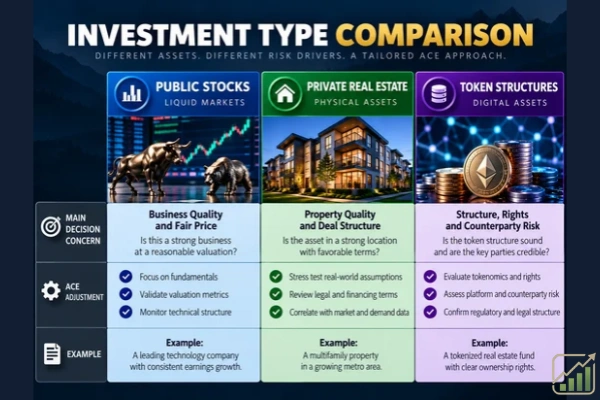
A publicly traded stock or ETF is generally easier to research, buy, sell, and monitor than a private investment. That does not make it automatically better. It simply changes the questions you need to ask.
Investment Type | Typical Access | Main Decision Concern | ACE Adjustment |
|---|---|---|---|
Public stocks and ETFs | Brokerage account | Valuation, business quality, price risk | Focus on research, position size, and exit rules |
Mutual funds and index funds | Brokerage or retirement account | Fees, holdings, allocation role | Focus on diversification and long term fit |
Private company shares | Private marketplace or issuer | Eligibility, limited liquidity, pricing | Add document review and liquidity screening |
Private real estate fund | Fund platform or sponsor | Fees, redemption limits, property strategy | Add sponsor, structure, and cash flow review |
Token equity structure | Specialized platform or protocol | Legal structure, conversion terms, custody | Confirm exactly what is owned and what rights apply |
For example, a listed company might be available to buy within seconds during market hours. A private opportunity can require more documentation, eligibility review, and a lengthy transaction process. Forge Global notes that one private ACE related company opportunity may involve identity and accreditation verification, bidding, and a settlement period that typically takes 45 to 60 days. Review the platform’s ACE Green Recycling transaction details before assuming a private investment works like a normal stock trade.
Fair warning: liquidity is not a minor detail. If you may need the money for an emergency fund, a home purchase, debt repayment, or near term retirement income, an investment that cannot be sold quickly may not fit, even if the thesis appears attractive.
Confirm What You Actually Own
The name of an investment does not always explain its legal or economic structure. A share of common stock, a fund unit, a limited partnership interest, a SAFE, and a token linked instrument can carry very different rights.
One ACE structure described by MetaLeX Labs involves eligible token holders converting some token holdings into an equity linked SAFE style instrument. That is materially different from buying a stock in a self directed brokerage account. Read the description of the token to equity ACE structure before treating any token related opportunity as ordinary equity ownership.
Ask these questions before proceeding:
• What legal instrument am I buying?
• What rights come with it, such as voting, distributions, redemption, or conversion rights?
• Who holds the asset or records ownership?
• Can the issuer create more shares, units, or tokens later?
• What event allows me to sell, redeem, convert, or receive proceeds?
If the answers are unclear, the appropriate ACE outcome is not “buy anyway.” It is Investigate Further or Reject.
Set Your Investor Constraints First
The process works best when I define limits before researching exciting ideas. Your constraints are the rules that keep a promising story from becoming an oversized portfolio risk.
Write down:
• Your goal, such as retirement growth, income, capital preservation, or a speculative allocation
• Your time horizon and when the money may be needed
• Your maximum portfolio exposure to one company, sector, or private investment
• Your maximum acceptable loss on a single position
• Your liquidity needs and emergency cash reserve
• Whether the investment belongs in a taxable, retirement, or other account type
This is the foundation for asset allocation. Asset allocation means deciding how much of your portfolio belongs in broad categories such as stocks, bonds, cash, real assets, or alternatives. A single investment decision should fit inside that broader plan, not replace it.
Follow The ACE Investing Process Step by Step
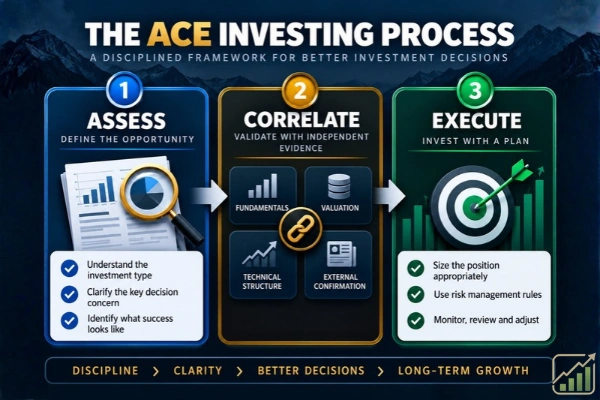
The ACE Method™ turns a possible investment into a documented decision. For a fuller framework, see What is the ACE method for investing. The key is to preserve the sequence. Do not jump from a headline or chart directly to execution. (Assess, correlate, execute investment decisions)
Step 1: Assess Whether The Opportunity Deserves Attention
Assess answers one question: Is this investment opportunity worth investigating?
This is a qualification stage, not a buy decision. The goal is to separate a possible opportunity from noise, hype, or a business you do not understand well enough to own.
For a public company, review the following areas:
• Business model and how the company makes money
• Revenue, earnings, cash flow, debt, and profitability trends
• Competitive position and industry conditions
• Valuation compared with the company’s own history, peers, and growth outlook
• Catalysts that could improve or weaken the thesis
• Major risks, including customer concentration, regulation, debt maturities, or cyclicality
For a fund or private deal, expand due diligence to include the offering documents, fee schedule, manager incentives, redemption rules, conflicts of interest, and reporting frequency. Private investments deserve more caution because current pricing may be less visible and a quick exit may not be possible.
A useful Assess worksheet has three possible outputs:
Assess Outcome | Meaning | Next Action |
|---|---|---|
Reject | The opportunity fails a core rule or is not understandable | Record the reason and move on |
Watch | The idea is interesting but not ready | Set a review date or price alert |
Investigate Further | The opportunity meets initial criteria | Move to Correlate |
Consider a profitable company with strong revenue growth. It may still be a poor investment if its debt is rising sharply, its valuation assumes years of flawless execution, or it duplicates an existing large position in your portfolio. Assess prevents the mistake of confusing a good company with a good investment at the current price and in your current portfolio.
Step 2: Correlate Independent Evidence
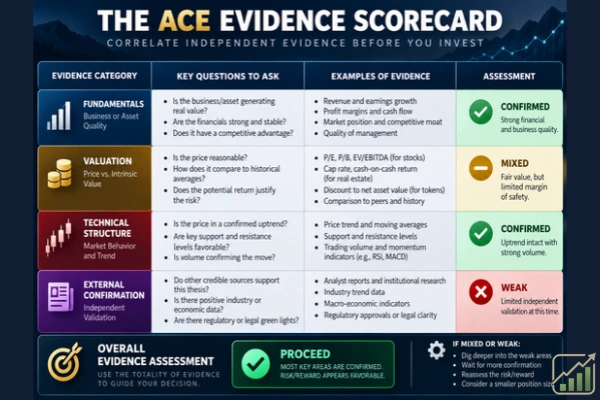
Correlate asks: Does enough independent evidence agree to justify taking risk?
This stage is not about finding one perfect indicator. It is about checking whether multiple sources of evidence point in the same direction or reveal meaningful disagreement. Fundamentals, valuation, technical structure, sector trends, macroeconomic conditions, and catalysts can each add useful context. They should not be treated as identical signals.
For example, rising sales and margins are related fundamental evidence. They matter, but they are not two entirely separate confirmations. A more independent check might be whether the company’s sector is improving, whether its balance sheet can support its growth plan, and whether price and volume behavior are consistent with investor demand.
Use a simple evidence scorecard:
Evidence Area | Questions To Ask | Possible Result |
|---|---|---|
Fundamentals | Is the business financially improving? | Supports, neutral, conflicts |
Valuation | Does the price leave room for realistic outcomes? | Supports, neutral, conflicts |
Technical structure | Is the trend stable or deteriorating? | Supports, neutral, conflicts |
Sector and macro | Are outside conditions helping or hurting? | Supports, neutral, conflicts |
Catalyst and risk | Is there a credible reason for change, and what could break it? | Supports, neutral, conflicts |
Portfolio fit | Does this improve diversification or add concentration? | Supports, neutral, conflicts |
The output should be Weak, Mixed, or Confirmed.
A Confirmed result does not mean certainty. It means the available evidence is sufficiently aligned for you to consider a planned risk. A Mixed result often means you should reduce position size, wait for more evidence, or continue monitoring. A Weak result means the thesis lacks enough support to justify action.
This is where confirmation bias is most likely to appear. If you want to buy a company because the story is compelling, deliberately look for evidence that could prove you wrong. Search for the strongest bearish case. Review what would invalidate your thesis. If contradictory evidence is substantial, do not hide it under a higher confidence score.
Step 3: Execute A Predefined Plan
Execute answers: Given the evidence, what is the best risk adjusted action?
The three possible outputs are Pass, Wait, or Execute. “Pass” is a valid decision. “Wait” is also a valid decision when valuation, technical conditions, or portfolio exposure are not favorable. Execution begins only when the plan is clear enough to follow under pressure.
Before placing an order, document:
Thesis: Why do I own this investment, in one or two sentences?
Entry plan: What price, range, or condition would trigger a purchase?
Position size: What percentage of the portfolio can this represent at purchase and after a loss or gain?
Risk limit: What loss, price level, business change, or thesis failure would require a review or exit?
Upside expectation: What outcome would show the thesis is working, and what would cause profit taking?
Time horizon: Is this a weeks long trade, a multiyear investment, or an illiquid holding with no predictable exit date?
Order review: Have I checked the symbol, account, quantity, order type, fees, and cash available?
Position size is where risk management becomes real. If a position is too large, even a normal decline can trigger emotional selling. If it is too small, it may have little effect on your portfolio. There is no universal percentage that works for every investor. A concentrated investor may accept larger individual positions; a retirement focused investor may set tighter limits. The important point is to make the rule before the trade, not after the price moves.
For an example, assume you have a $100,000 portfolio and decide that a new stock position should not exceed 4% of the portfolio at cost. Your initial investment is $4,000. If your analysis says a 15% decline would invalidate the setup, the estimated position level at that point is about $3,400, or a $600 decline before fees and taxes. That calculation does not predict a loss. It tells you whether the planned risk fits your limit before you buy.
Build Risk Controls Around Every Decision
ACE is most useful when it continues after the purchase. Investors often treat buying as the finish line. It is only the start of the monitoring phase.
Protect Portfolio Diversification
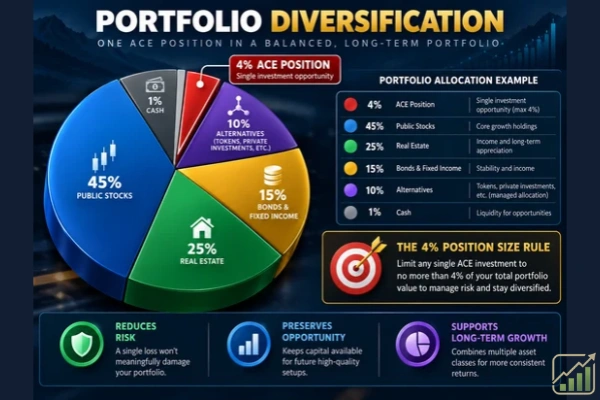
Portfolio diversification does not mean owning as many symbols as possible. It means avoiding a situation where one business, sector, factor, or market event can dominate the outcome.
For instance, owning five technology companies that depend on similar advertising spending or cloud demand may look diversified by ticker count but still carry concentrated economic exposure. The same issue can occur when an investor owns a broad market ETF and then adds several large positions that are already major holdings inside that ETF.
Review concentration across:
• Individual holdings
• Sectors and industries
• Asset classes
• Geographic exposure
• Investment style, such as growth, value, income, or speculative assets
• Liquidity, especially the portion of capital locked in private investments
A private investment can require a smaller allocation than a public stock because the inability to sell is an added risk. When a position cannot be rebalanced easily, its weight can become uncomfortable precisely when conditions worsen.
Monitor The Thesis, Not Every Price Move
Daily price changes can be noisy. Monitoring should focus on events that affect the original thesis.
Create a review schedule and a short journal entry for each position. Include the purchase date, thesis, position size, risk limit, expected holding period, and reasons to sell. Then update the record when meaningful information changes.
Examples of review triggers include:
• Earnings results that materially alter the growth or profitability outlook
• A dividend cut, major debt increase, or significant dilution
• A management change or regulatory event that changes the risk profile
• A break in the technical level or business condition that supported the entry
• A position becoming too large relative to your diversification limits
Do not confuse volatility with invalidation. A stock can decline while the long term thesis remains intact. On the other hand, an investor should not use a long time horizon as an excuse to ignore deteriorating facts. The journal helps distinguish a normal drawdown from a reason to reassess.
Use A Recovery Process After A Bad Decision
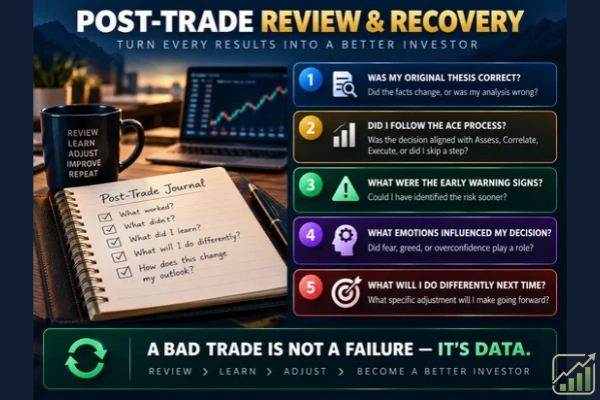
Losses are part of investing. The question is whether a loss came from a normal uncertain outcome or a preventable process failure.
After closing a position, review it without rewriting history. Ask:
• Did I follow my Assess criteria?
• Did I give conflicting evidence enough weight during Correlate?
• Was the position size appropriate for the risk?
• Did I follow the execution and exit plan?
• What rule, if any, needs revision?
If the process was sound but the outcome was unfavorable, that does not automatically require a new strategy. If the loss resulted from skipping document review, ignoring concentration, or moving a risk limit after the fact, the correction should be procedural.
For more practical frameworks that support this discipline, browse the Investment process category. The goal is not to eliminate uncertainty. It is to make each decision explainable, repeatable, and proportionate to the risk.
Key Takeaways
• ACE investing is a decision system, not a promise that a particular stock, fund, or platform will perform well.
• Start by identifying the investment structure. Public securities, private funds, token linked arrangements, and private company shares require different due diligence.
• Assess determines whether an opportunity deserves attention. A company can be strong while its stock remains unsuitable at a particular price or for a particular portfolio.
• Correlate checks whether independent evidence supports the thesis. Conflicting evidence should lower confidence, reduce size, or justify waiting.
• Execute turns research into a written plan for entry, position size, downside risk, monitoring, and exit conditions.
• Portfolio diversification, liquidity limits, and position sizing are not separate from the ACE process. They determine whether a good idea is appropriate for you.
A disciplined process cannot guarantee returns. It can help you avoid making major decisions based only on excitement, fear, or a single data point.
Frequently Asked Questions
What Does ACE Investing Mean For A Self Directed Investor?
ACE means Assess, Correlate, Execute. It is a structured way to evaluate an investment, test whether the evidence supports the thesis, and act only after defining risk controls. It does not replace your judgment or guarantee investment results.
Is ACE A Recognized Universal Investing Standard?
No single authoritative U.S. standard defines one universal ACE investing process. The term can refer to different products, platforms, or methodologies. The ACE Method™ described here is a decision framework for evaluating opportunities rather than a specific security or investment product.
Does The ACE Process Work For ETFs, Stocks, And Private Investments?
Yes, but the due diligence changes. Stocks and ETFs require research into holdings, valuation, market risk, and portfolio role. Private investments require additional review of legal documents, fees, eligibility, liquidity, valuation methods, and exit restrictions.
Do Private ACE Opportunities Require Accredited Investor Status?
Some may. Requirements depend on the specific offering and platform. Do not assume eligibility based on the investment name. Read the offering terms and complete any required verification before treating the opportunity as available capital allocation.
How Much Money Do I Need To Start Using ACE?
You can use the process with any amount because the first steps involve research, portfolio limits, and written rules. The minimum investment depends on the brokerage, fund, platform, or security. A small account may benefit from simpler diversification, such as broad funds, rather than many small individual positions.
How Do I Know Whether To Wait Instead Of Buy?
Wait when the evidence is mixed, the price does not fit your valuation or entry rules, your portfolio is already concentrated, or you cannot explain the downside. Waiting is an execution decision, not a failure to act.
What Should I Track After Buying An Investment?
Track the original thesis, purchase price, position size, planned risk limit, expected holding period, material company or fund developments, and reasons to sell. Review information that affects the thesis rather than reacting to every market move.
Sources And References
• Forge Global — Buy and Sell ACE Green Recycling Stock: https://forgeglobal.com/ace-green-recycling_stock/
• MetaLeX Labs — ACE: Making Tokens More Investable Through Equity Alignment: https://x.com/MetaLeX_Labs/article/2042260533827539120
Disclaimer:
This article is for educational purposes only and does not constitute financial, investment, or legal advice. Always consider your own financial situation and, if needed, consult a licensed financial professional.