
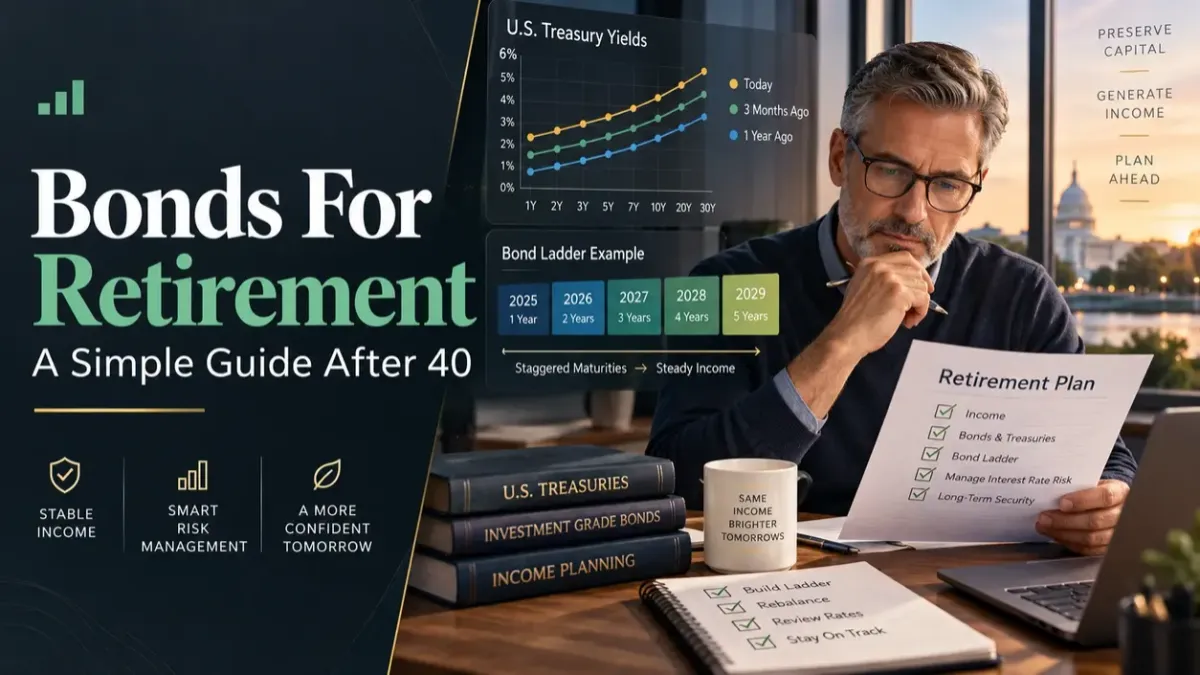
Bonds For Retirement: A Simple Guide After 40
If you're over 40 and behind on retirement, somebody has probably told you to "add some bonds." That advice isn't wrong, but it's incomplete, and the incomplete part can cost you.
Here's the honest truth: bonds will not catch you up. Stocks do the catching up. Bonds have a different job. They keep a bad market year from forcing you to sell stocks at the bottom, and they fund the specific years right before and after you stop working. Every bond decision you make should be judged against that job.
I'm 54 and I work in operations in the oil and gas industry. I've spent more than two decades in a business where prices can drop 50% in a year and budgets get cut overnight, so I don't trust any plan that only works when markets cooperate.
I'm planning to retire at 62. That means I'm about eight years from the point where a bad market year stops being a buying opportunity and starts being a threat to my income. That's exactly when the job of bonds changes.
I'm not a financial advisor. I'm someone doing this for real with my own money, and I'm showing you the reasoning so you can apply it to your situation.
This guide covers what you actually need to know, skips what you don't, and tells you where most late starters go wrong.
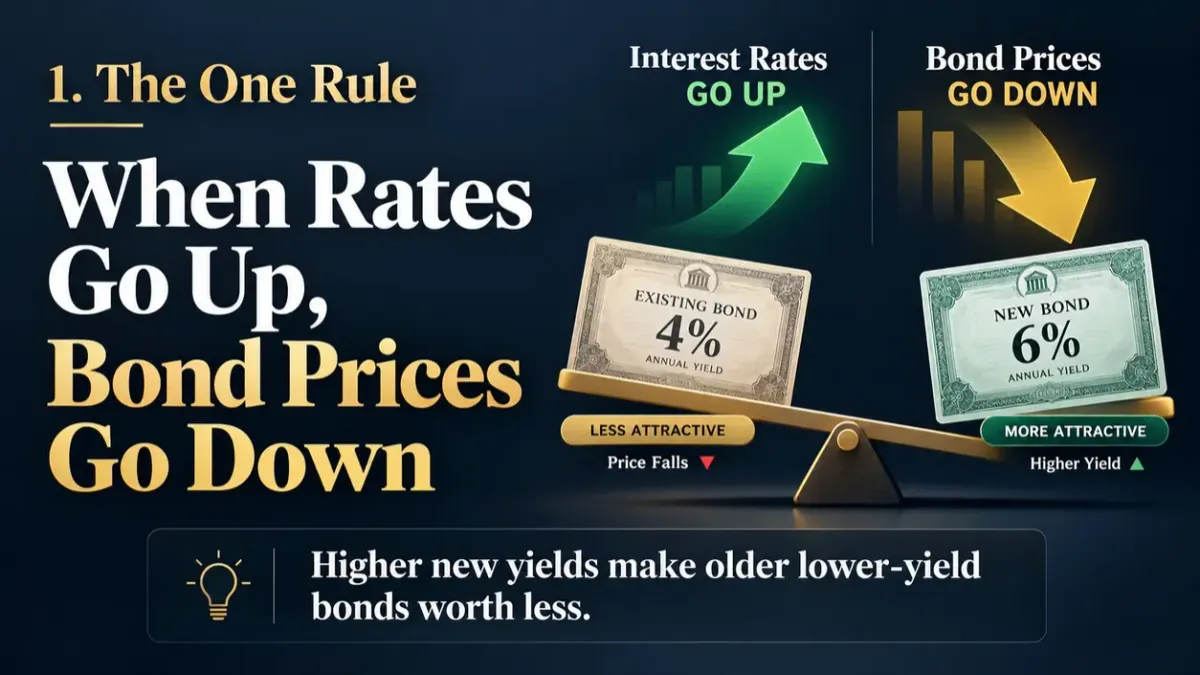
1. The One Rule: When Rates Go Up, Bond Prices Go Down
A bond is an IOU. You lend $1,000, and the borrower pays you a fixed rate until the loan comes due.
Say you own a $1,000 bond paying 4%, or $40 a year. Then interest rates rise and new bonds pay 6%, or $60 a year. Nobody will pay you full price for your $40 bond when they can buy a $60 bond down the street. So if you need to sell, you sell at a discount. Flip it around and the same logic works in your favor: when rates fall, your older, higher paying bond becomes worth more than $1,000.
That's not theory. In 2022, when rates jumped fast, the broad U.S. bond market lost about 13%, and long term Treasury funds lost roughly 30%. The "safe" half of a lot of portfolios had its worst year in decades.
The lesson: safe from default is not the same as safe from price swings.
The number that tells you how much it will hurt: duration
Every bond fund lists a number called duration. Use this rule of thumb: if rates rise 1 percentage point, the fund drops by roughly its duration in percent.
Duration of 2 years: about a 2% drop
Duration of 6 years: about a 6% drop
Duration of 17 years: about a 17% drop
Match duration to when you'll need the money. Cash you'll spend in three years has no business sitting in a fund with a duration of 17. For a deeper comparison, see Short Term Bonds Vs Long Term Bonds For Retirement.
2. The Yields That Matter
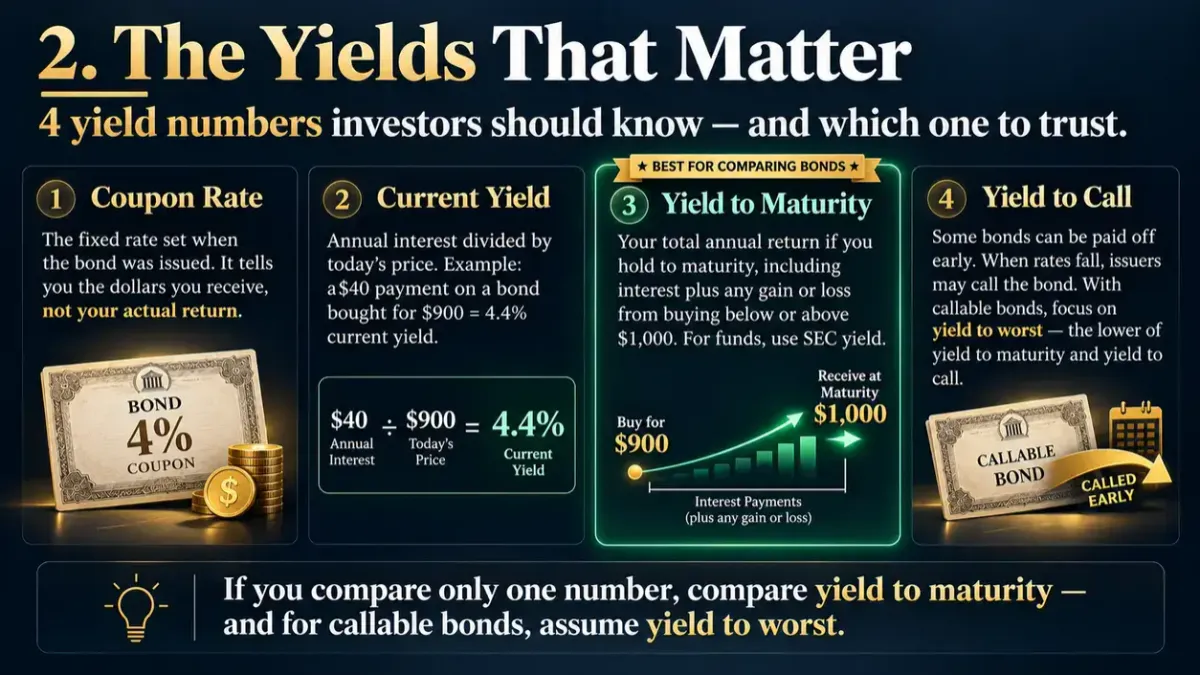
You'll see four yield numbers. Here's what they mean and which one to trust.
Coupon rate. The fixed rate set when the bond was issued. It tells you the dollars you receive, not your actual return.
Current yield. Annual interest divided by today's price. A $40 payment on a bond you bought for $900 is a 4.4% current yield.
Yield to maturity. Your total annual return if you hold to the end, counting the interest plus any gain or loss from buying below or above $1,000. This is the number to compare bonds with. For funds, look at the SEC yield instead.
Yield to call. Some bonds let the issuer pay you back early. They do that when rates fall, which is exactly when you'd want to keep the bond. With callable bonds, look at "yield to worst," the lower of yield to maturity and yield to call. Assume the worst one happens.
3. Treasuries: The Backbone Of The Bond Side
U.S. Treasuries are backed by the federal government. The chance of default is as close to nothing as investing gets. The price risk from Section 1 still applies.
| Type | Term | How It Pays |
|---|---|---|
| Treasury bills | 4 to 52 weeks | Bought at a discount, redeemed at full value. No interest checks. |
| Treasury notes | 2 to 10 years | Interest paid every six months |
| Treasury bonds | 20 or 30 years | Interest paid every six months |
Treasury interest is taxed federally but not by your state. If you live in a high tax state, that's real money.
My take for late starters: bills and short notes are the best place for money you'll need within a few years. Long Treasury bonds are a rate bet, not a safety net. You can buy directly at TreasuryDirect, but buying through a brokerage account makes it much easier to sell before maturity if life happens.
If inflation worries you more than rates, Treasuries also come in an inflation protected version. See TIPS For Retirement: How They Work.
4. Municipal Vs Corporate Bonds: Do The After Tax Math
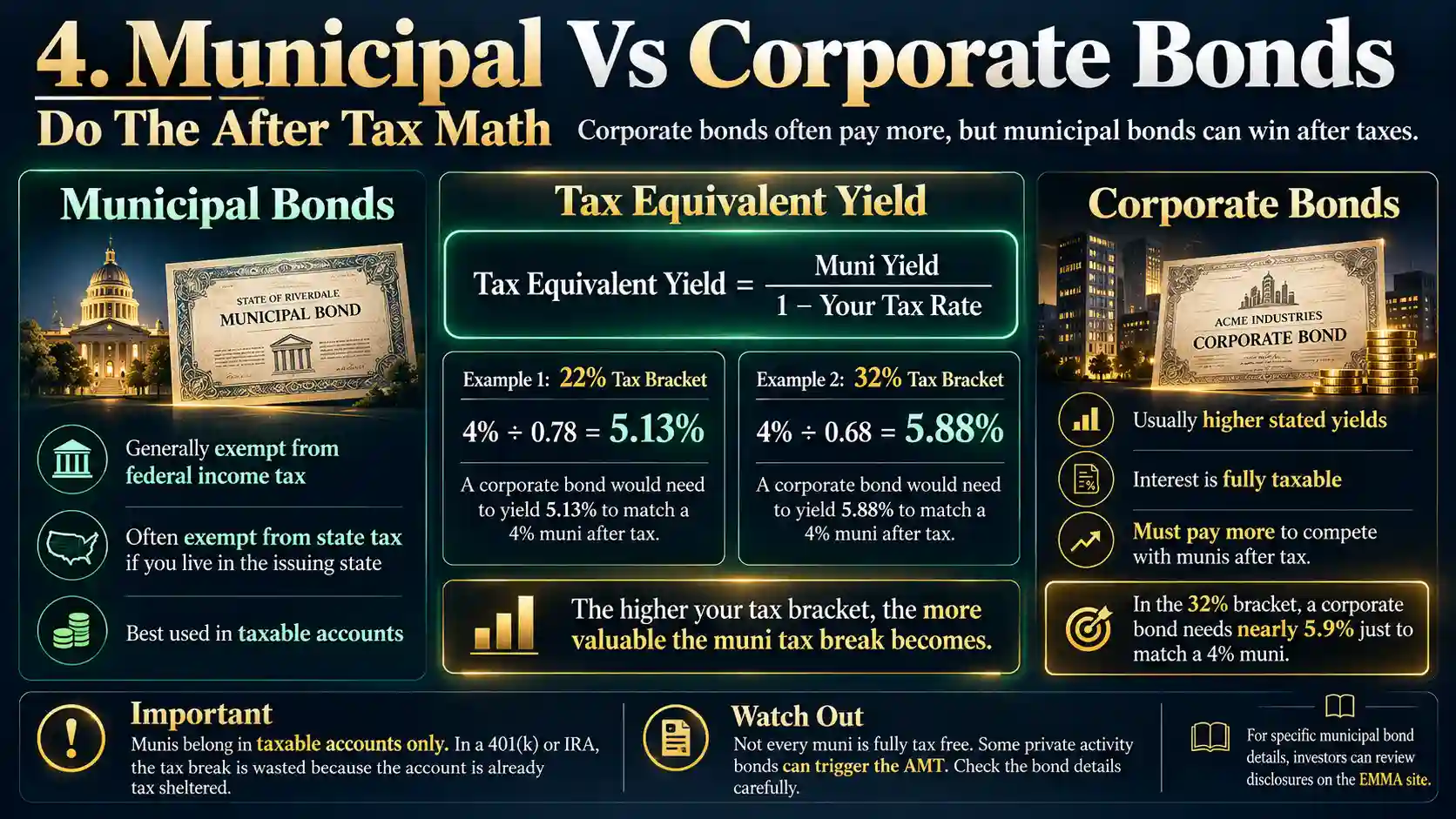
Corporate bonds pay more but are fully taxable. Municipal bonds, issued by states and cities, are generally free from federal income tax and often from state tax if you live in the issuing state.
To compare them fairly, calculate the tax equivalent yield:
Tax Equivalent Yield = Muni Yield ÷ (1 minus Your Tax Rate)
A 4% muni works out like this:
In the 22% bracket: 4% ÷ 0.78 = 5.13%
In the 32% bracket: 4% ÷ 0.68 = 5.88%
So in the 32% bracket, a corporate bond has to pay almost 5.9% just to match that muni after tax. Add state tax and the gap gets wider.
Two things most guides leave out:
Munis belong in taxable accounts only. Inside a 401(k) or IRA, the tax break is wasted because that money is already sheltered. You'd be accepting a lower yield for nothing. More on this in Should You Hold Bonds In Taxable Accounts?
Not every muni is fully tax free. Some "private activity" bonds can trigger the alternative minimum tax. You can look up any muni's details for free on the MSRB's EMMA site.
5. Credit Risk: Don't Reach For Yield
Rating agencies grade borrowers. BBB and above is investment grade. BB and below is high yield, also called junk.
When you're behind, a 9% yield looks like a shortcut. It isn't. In 2008, high yield bonds lost roughly a quarter of their value while Treasuries went up. Junk bonds tend to fall at the same time stocks do, which is exactly when you need your bonds to hold steady.
My rule: take your risk on the stock side, where you're paid for it over time. Keep the bond side boring. Investment grade corporate bonds are fine in moderation, usually through a broad fund. Junk bonds don't belong in a catch up plan.
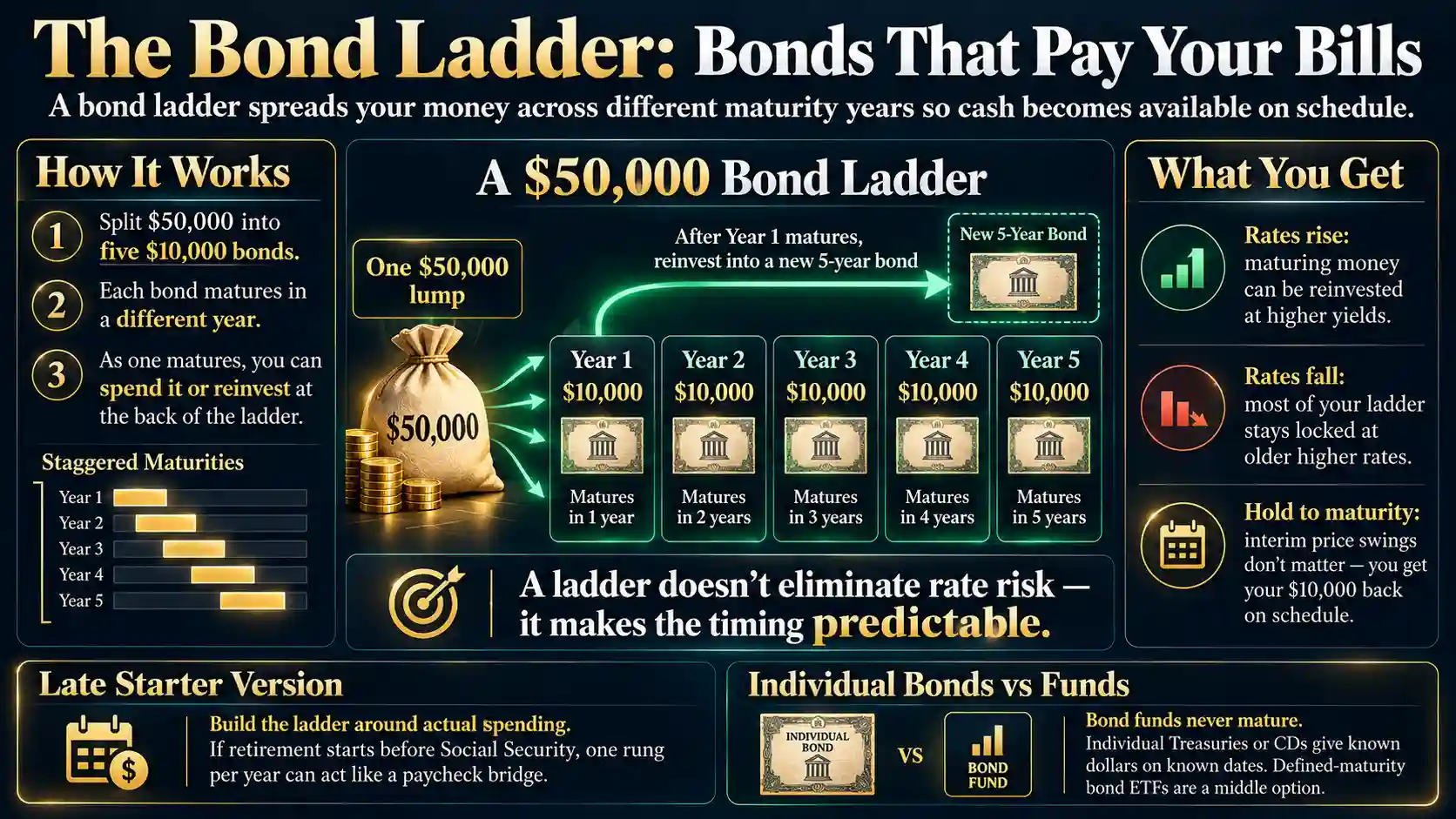
6. The Bond Ladder: Bonds That Pay Your Bills
A ladder spreads your money across bonds that mature in different years.
Instead of putting $50,000 into one 5 year bond, you split it into five $10,000 pieces maturing in years 1, 2, 3, 4, and 5. Each year, one piece matures. If you don't need the cash, you reinvest it in a new 5 year bond at the back of the ladder.
What that gets you:
If rates rise, you reinvest maturing money at the higher rates every year.
If rates fall, most of your money is still locked in at the older, higher rates.
If you hold each bond to maturity, the price swings in between don't matter. You get your $10,000 back on schedule.
A ladder doesn't eliminate rate risk. It makes it predictable, and predictable is what you want near retirement.
The late starter version: build the ladder around your actual spending. If you plan to retire before claiming Social Security, a ladder that matures one rung per year across that gap turns bonds into a paycheck. That's the most useful thing bonds can do for someone in our position.
Individual bonds or funds? A bond fund never matures, so there's no guaranteed date you get your money back. A ladder of individual Treasuries or CDs gives you known dollars on known dates. Defined maturity bond ETFs, which close out in a set year, are a middle option. For the fund side, see Bond Funds For Retirement: What People Over 40 Need To Know.
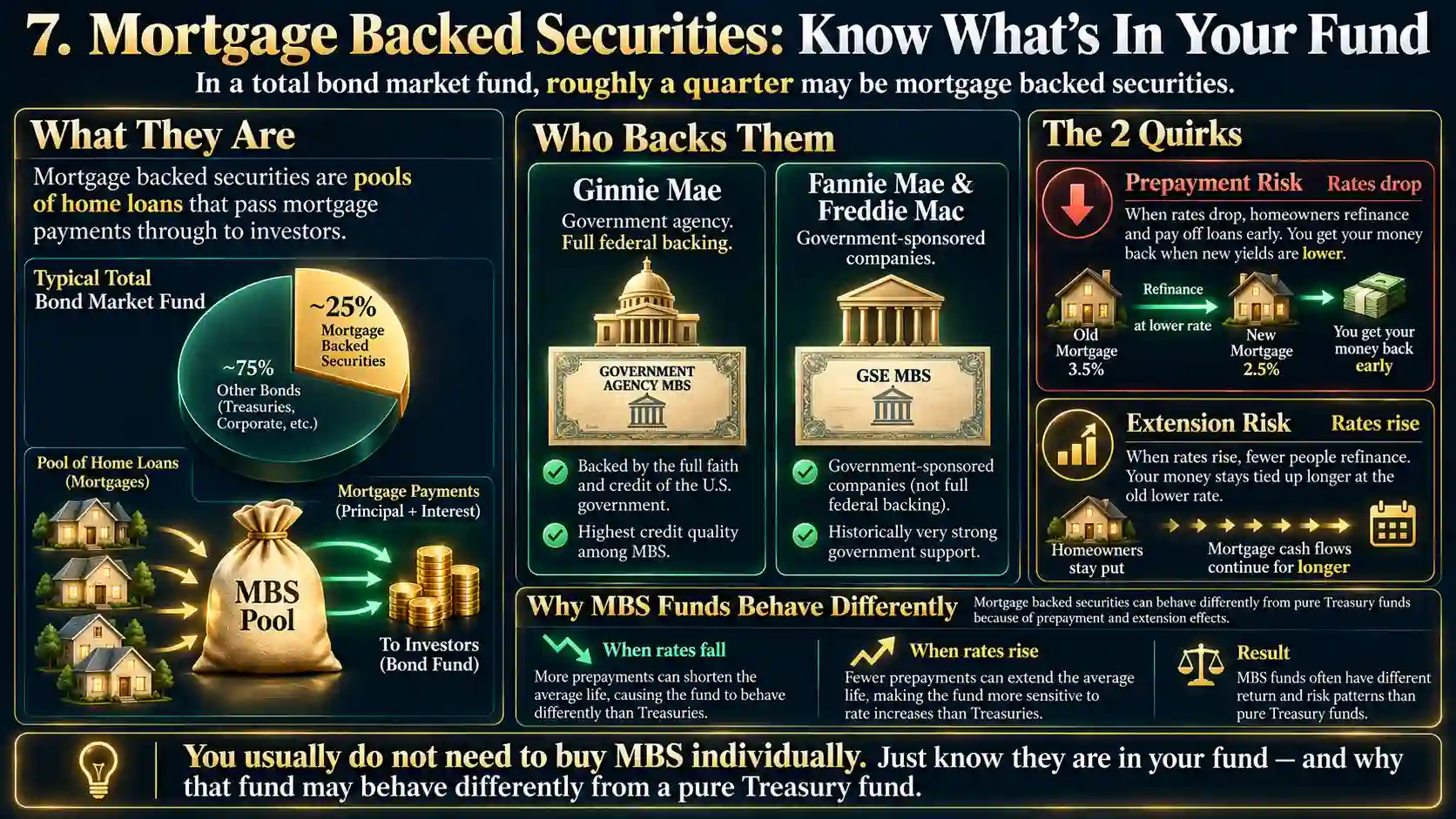
7. Mortgage Backed Securities: Know What's In Your Fund
If you own a total bond market fund, roughly a quarter of it is probably mortgage backed securities. These are pools of home loans that pass mortgage payments through to investors.
Some are backed by Ginnie Mae, a government agency with full federal backing. Others come from Fannie Mae and Freddie Mac, which are government sponsored companies.
They come with two quirks:
Prepayment risk. When rates drop, homeowners refinance and pay off their loans early. You get your money back right when you can only reinvest it at lower rates.
Extension risk. When rates rise, nobody refinances, so your money stays tied up longer at the old lower rate.
You don't need to buy these individually. Just know they're in your fund and why that fund can behave differently from a pure Treasury fund.
The Bond Checklist For Late Starters
Run every bond decision through these six questions:
What's the job? Emergency cash, a known expense, or cushion against stock crashes?
Does the duration match the date? Money needed soon goes short.
Is it in the right account? Munis in taxable accounts. Taxable bonds in retirement accounts when possible.
Am I looking at the right yield? Yield to worst for individual bonds, SEC yield for funds.
Am I reaching? If it's below investment grade, the answer is yes.
Would a ladder fit this better? For any expense with a known date, usually yes.
The Bottom Line
Bonds won't make you rich, and they aren't supposed to. Their job is to protect the plan so the growth side can do its work. Keep them short where you need cash, boring where you need stability, and in the right account for taxes.
For more on the basics from the regulators themselves, see FINRA's guide to bonds and Investor.gov.
Educational Mission
All content on ExecutionSignals.com is strictly created for educational purposes based on general investment principles and the FINRA SIE curriculum.
Transparency
I do not accept kickbacks from sketchy brokerages, sell speculative stock picks, or recommend high-risk financial instruments.
Regulatory Disclaimer
I am an independent market researcher and SIE candidate. I am not a Registered Investment Advisor (RIA), Broker-Dealer, or Certified Financial Planner (CFP). Content on this site does not constitute individualized financial advice, trade solicitations, or formal portfolio management.
Disclaimer: Execution Signals is for educational and informational purposes only and does not provide financial or investment advice. Investing involves risk, including loss of capital. Results are not guaranteed.


©2026 All rights reserved | Execution Signals, LLC | Disclaimer | Privacy Policy | Terms | Earnings
307-424-1776 | 30 N Gould St #64899 Sheridan, WY, 82801, USA