
Stock Position Size Calculator
Calculate how many shares to buy based on your portfolio value, planned entry price, stop-loss price, and maximum risk.
Instead of guessing at position size, use a repeatable formula to determine how much capital you can put at risk before placing the trade.
Stock Position Size Calculator
Enter your portfolio value, maximum risk, planned entry price, and stop-loss price.
Get More Free Investor Tools
The Position Size Calculator is just one of the tools available from Execution Signals.
Create your free Execution Signals account to access the Execution Signals Tools Portal
and our growing collection of investing, risk, retirement, and financial planning tools.
Free account. No credit card required.
What Your Position Size Result Means
Your result is based on the amount of your portfolio you are willing to risk and the distance between
your planned entry and stop-loss price.
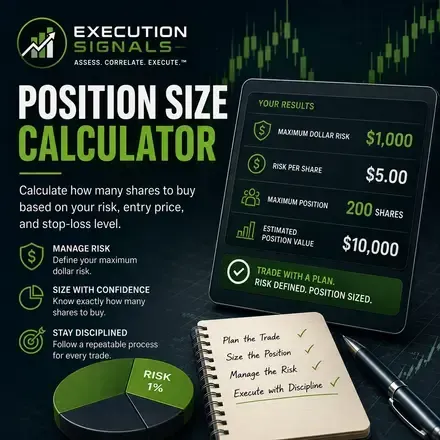
A typical result may look like this:
Maximum Position: 200 shares
Maximum Planned Risk: $1,000
Estimated Position Value: $10,000
That does not mean you should automatically buy 200 shares.
It means 200 shares would be the maximum position allowed by the risk assumptions you entered.
You still need to decide whether the investment itself makes sense.
How to Calculate Stock Position Size
Position sizing starts with one question:
How much am I willing to lose if this trade does not work?
Once you know that number, the position-size calculation becomes straightforward.
Determine Your Maximum Dollar Risk
Multiply your portfolio value by the percentage you are willing to risk on the trade.
Maximum Dollar Risk = Portfolio Value × Risk Percentage
Example:
Portfolio Value: $100,000
Maximum Risk: 1%
Maximum Dollar Risk: $1,000
Before buying anything, you have already decided that approximately $1,000 is the maximum planned loss you are willing to accept on the trade.
Calculate Risk Per Share
Risk per share is the difference between your planned entry price and your stop-loss price.
For a long position:
Risk Per Share = Entry Price − Stop-Loss Price
Example:
Entry Price: $50
Stop-Loss Price: $45
Risk Per Share: $5
Each share represents approximately $5 of planned risk.
Calculate the Maximum Number of Shares
Divide your maximum dollar risk by your risk per share.
Maximum Shares = Maximum Dollar Risk ÷ Risk Per Share
Using the same example:
$1,000 ÷ $5 = 200 shares
That gives you a risk-based maximum position of 200 shares.
Position Size Calculation Example
Let's put the entire calculation together.
Portfolio
Portfolio Value: $100,000
Maximum Risk Per Trade: 1%
Maximum Planned Dollar Risk: $1,000
Trade
Planned Entry Price: $50
Stop-Loss Price: $45
Risk Per Share: $5
Position Size
$1,000 Maximum Risk ÷ $5 Risk Per Share = 200 Shares
At a $50 entry price:
200 shares × $50 = $10,000 Position Value
That means the trade would represent approximately 10% of the $100,000 portfolio.
If the position were closed at the planned $45 stop price, the estimated loss would be approximately:
200 shares × $5 risk per share = $1,000
Again, this is a planned loss based on the stop price entered.
Actual market losses can differ.
Why Position Sizing Matters
A good investment idea can still hurt your portfolio if the position is too large.
Position sizing helps answer:
How much of this stock should I own?
Without a position-sizing process, investors often make decisions based on confidence.
They may invest more because they "really like" a stock.
They may buy an arbitrary dollar amount.
Or they may concentrate too much of their portfolio in one position without realizing
how much capital is actually at risk.
Position sizing replaces that guesswork with a rule.
You decide your risk first.
The share count comes second.
What Is Risk Per Share?
Risk per share measures the difference between your planned entry price and the price where
you intend to exit if the trade moves against you.
For example:
Entry: $80
Stop: $74
Risk Per Share: $6
If you own 100 shares:
100 × $6 = $600 of planned risk
If you own 500 shares:
500 × $6 = $3,000 of planned risk
The stock is exactly the same.
The only thing that changed was the position size.
That's why position sizing can have such a large effect on portfolio risk.
How Much Should You Risk on One Trade?
There is no single percentage that is appropriate for every investor.
The amount you choose depends on factors such as:
- Portfolio size
- Risk tolerance
- Investing experience
- Strategy
- Time horizon
- Number of open positions
- Overall portfolio concentration
Some investors use 1% of portfolio value as a risk-management guideline.
Others choose less.
The percentage itself matters less than having a rule you understand and can consistently follow.
For example:
| Portfolio Value | 0.5% Risk | 1% Risk | 2% Risk |
|---|---|---|---|
| $25,000 | $125 | $250 | $500 |
| $50,000 | $250 | $500 | $1,000 |
| $100,000 | $500 | $1,000 | $2,000 |
| $250,000 | $1,250 | $2,500 | $5,000 |
| $500,000 | $2,500 | $5,000 | $10,000 |
Higher risk percentages increase both potential gains and potential losses. The purpose of the
calculator is not to tell you which risk percentage to use.
Its purpose is to show what your chosen risk level means in actual dollars and shares.
Why Position Size and Portfolio
Allocation Are Different
Position size and portfolio allocation are related, but they answer different questions.
Position Size
Position sizing asks:
How many shares can I buy while staying within my planned risk?
It considers:
- Portfolio value
- Maximum risk percentage
- Entry price
- Stop-loss price
Portfolio Allocation
Portfolio allocation asks:
How much of my total portfolio should be invested in this position?
Those two calculations can produce very different answers.
Imagine:
Portfolio: $100,000
Risk Limit: 1%
Entry: $50
Stop: $49.75
Risk Per Share: $0.25
A pure risk calculation would allow:
$1,000 ÷ $0.25 = 4,000 shares
But:
4,000 × $50 = $200,000
That position is twice the value of the portfolio.
This is why the Execution Signals calculator also allows you to apply a maximum portfolio allocation
limit.
The final position should respect both your risk limit and your portfolio-allocation rules.
How Does a Stop Loss Affect Position Size?
The farther your stop is from your entry, the more risk you have per share.
That generally means you can buy fewer shares while keeping the same maximum dollar risk.
The closer your stop is to your entry, the less risk you have per share.
That may allow more shares.
Example:
Trade A
Entry: $50
Stop: $45
Risk Per Share: $5
With $1,000 maximum risk:
$1,000 ÷ $5 = 200 shares
Trade B
Entry: $50
Stop: $48
Risk Per Share: $2
With the same $1,000 maximum risk:
$1,000 ÷ $2 = 500 shares
This does not mean closer stops are automatically better.
A stop should make sense for the trade itself.
Moving a stop closer simply to increase your position size can cause you to exit a normal price movement
prematurely.
Can a Stop Loss Guarantee My Maximum Loss?
No.
A stop-loss order can help manage risk, but it does not guarantee that your trade will exit at the exact stop price.
Stocks can gap through a stop.
This can happen after:
- Earnings reports
- Major company announcements
- Economic news
- Market shocks
- Overnight developments
- Periods of low liquidity
For example:
You enter at $50.
Your stop is $45.
Bad news is released overnight.
The stock opens at $40.
Your actual exit could occur below your planned $45 stop.
That means your real loss may be larger than the calculator estimated.
Position sizing is a risk-management tool.
It does not eliminate investment risk.
Should I Use the Same Position Size for Every Stock?
Not necessarily.
Two stocks may have very different volatility and stop distances.
Consider:
Stock A
Entry: $100
Stop: $95
Risk Per Share: $5
Stock B
Entry: $100
Stop: $80
Risk Per Share: $20
If your maximum planned risk is $1,000:
Stock A:
$1,000 ÷ $5 = 200 shares
Stock B:
$1,000 ÷ $20 = 50 shares
The position sizes are different because the risk is different.
That's the point.
A disciplined sizing process adjusts the number of shares to the risk of the individual setup.
How Should I Interpret My Result?
Treat the calculated share count as a maximum based on the assumptions you entered.
It is not a recommendation to buy that many shares.
Before acting, ask:
- Do I understand the company?
- Does the investment fit my strategy?
- Does the chart support the setup?
- Is the risk/reward acceptable?
- Are important catalysts approaching?
- Does this position fit my overall portfolio?
- Is my stop based on a logical price level?
- Am I comfortable with the potential dollar loss?
The calculator answers:
- How much could I buy within my risk rules?
It does not answer:
- Should I buy this investment?
Those are two very different questions.
Position Size Is Only One Part of the Decision
Position sizing tells you how much capital you can put at risk.
It does not tell you whether the investment deserves your capital in the first place.
That's why Execution Signals uses the ACE Method™.
Assess
Understand the business and the opportunity.
Correlate
Evaluate the chart, risk/reward, position size, catalysts, and portfolio fit.
Execute
Create the plan and follow it without allowing emotion to take control.
Assess → Correlate → Execute
Related Investor Tools
Position sizing becomes much more useful when combined with other parts of your
investment plan.
Risk/Reward Calculator
Compare your planned downside with your potential upside before entering a trade.
Stop-Loss Calculator
Estimate the percentage and dollar distance between your planned entry and stop.
[Use the Stop-Loss Calculator
Profit/Loss Calculator
Estimate the potential dollar and percentage gain (or loss) on a position you want.
Compound Growth Calculator
Explore how investments and ongoing contributions could grow over longer periods.
Make the Decision Before You Make the Trade
The goal of position sizing isn't to avoid every loss.
Losses are part of investing.
The goal is to understand the potential risk before you commit your capital.
Decide your risk.
Calculate your position.
Build the plan.
Then execute.
Assess. Correlate. Execute.™
Disclaimer:
Execution Signals calculators are provided for educational and informational purposes
only and do not constitute financial, investment, legal, or tax advice. Calculator results
are estimates based on the information entered. Actual investment results may differ
due to price gaps, slippage, liquidity, fees, taxes, market volatility, and other factors.
Investing involves risk, including the possible loss of principal.
7 Retirement Mistakes That Quietly Cost People Hundreds Of Thousands
Disclaimer: Execution Signals is for educational and informational purposes only and does not provide financial or investment advice. Investing involves risk, including loss of capital. Results are not guaranteed.
©2026 All rights reserved | Execution Signals, LLC | Disclaimer | Privacy Policy | Terms | Earnings
307-424-1776 | 30 N Gould St #64899 Sheridan, WY, 82801, USA