

Behind on Retirement? Calculate What You Need to Retire in 10, 15, or 20 Years
You don't need another article telling you to "save more for retirement." You already know that. What you actually need is a specific dollar amount - the real number that tells you whether your current pace gets you to retirement in 10 years, 15 years, or 20, and what has to change if it doesn't.
Generic advice like "save 15% of your income" or "aim for 10 times your salary" assumes you have decades of runway left. If you're reading this, your timeline is probably shorter than that, and shortcuts stop working when time is limited.
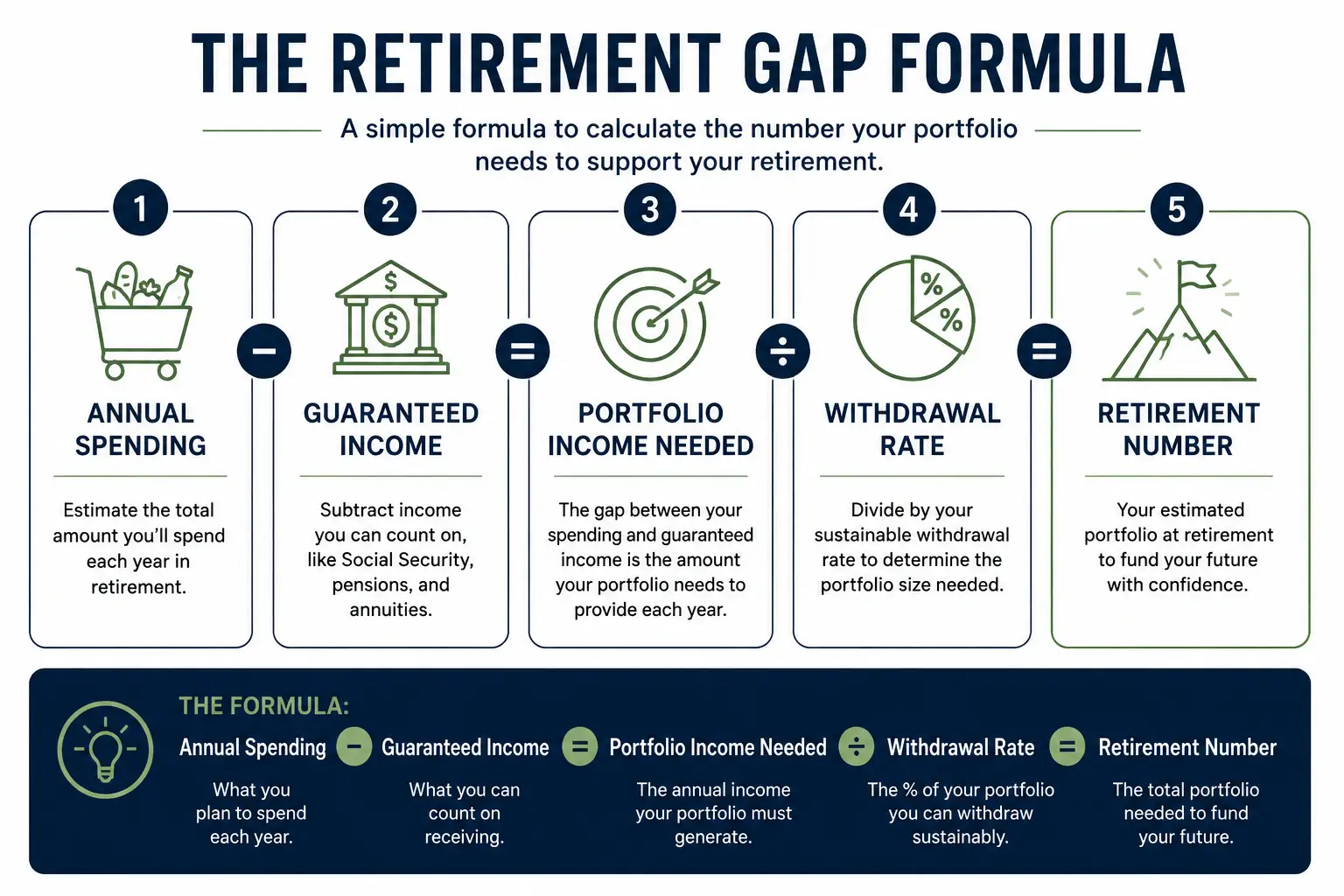
What works instead is a straightforward calculation: figure out what you'll actually spend, subtract what's guaranteed, and determine exactly how much your portfolio needs to cover the rest.
This article walks through that calculation step by step, then applies it to three realistic timelines - 10, 15, and 20 years - so you can see exactly where you stand and what adjustments would close the gap.
Quick Answer: How Much Do You Need to Retire?
The amount you need to retire depends on five variables: your retirement spending, your guaranteed income, your current savings, your timeline, and your expected investment return. There's no universal number - only your number.
The core calculation looks like this:
Annual retirement spending - guaranteed retirement income = annual portfolio income needed
Annual portfolio income needed ÷ withdrawal rate = estimated retirement portfolio required
Example: A household spending $80,000 a year in retirement, with $42,000 coming from Social Security and a pension, needs their portfolio to generate $38,000 annually. Using a 4% withdrawal rate:
$$$38,000 \div 0.04 = $950,000$$
That's the entire framework in miniature. The rest of this article breaks each piece down and applies it to compressed timelines.
Step 1: Estimate Your Annual Retirement Spending
Your retirement number starts with spending, not salary. A household earning $150,000 today might only need $90,000 a year in retirement once a mortgage is paid off and commuting costs disappear. Another household earning the exact same income might need $130,000 because of travel goals, ongoing debt, or higher healthcare needs.
To estimate your number, work through these categories realistically rather than optimistically:
Housing - will your mortgage be paid off, or are you downsizing, relocating, or renting?
Healthcare - costs typically rise faster than general inflation, especially before Medicare eligibility at 65.
Food and transportation - often lower than working-years spending, but rarely as low as people assume.
Travel and lifestyle - many retirees spend more in the first decade of retirement than later on.
Taxes - withdrawals from traditional accounts are taxable income.
Debt - any remaining mortgage, auto, or credit card payments increase your required income.
A common mistake is using a percentage of current salary (like 80%) as a shortcut. It's a reasonable starting estimate, but your actual retirement spending should be built from real numbers, not a rule of thumb pulled from a generic article.
Step 2: Subtract Social Security, Pension, and Other Guaranteed Income
Once you know your spending target, subtract every source of income you can count on regardless of market performance:
Social Security - use your actual estimate from ssa.gov, not a rough guess.
Pensions - if you have one, use the guaranteed monthly benefit.
Annuities - income annuities providing guaranteed payments.
Rental income - use net income only, after expenses, vacancies, repairs, property taxes, and management costs. Gross rental income overstates what's actually available.
Part-time or phased retirement income - include only if it's a realistic, planned part of your strategy, not a hopeful assumption.
Be conservative here. It's tempting to count income that feels likely but isn't guaranteed — a spouse's potential inheritance, an expected home sale, or optimistic rental assumptions. If it's not contractually guaranteed or highly reliable, treat it as a bonus to your plan, not a pillar of it.
Step 3: Calculate Your Portfolio Income Gap
This step converts your spending target and guaranteed income into a single, critical number: how much annual income your investment portfolio actually needs to produce.
Retirement spending – Social Security – pension – other reliable income = portfolio income gap
Example:
This $38,000 is the number your entire investment strategy exists to support. Everything from your savings rate to your asset allocation should be built around closing this specific gap - not around a vague sense that you should "save more."
Step 4: Estimate Your Required Portfolio
Once you know your annual portfolio income gap, divide it by a sustainable withdrawal rate to estimate the total portfolio size you need at retirement. It's important to view the withdrawal rate as a planning assumption, not a guarantee — market performance, sequence of returns, and your own spending flexibility all affect how sustainable a given rate actually is.
Here's how the required portfolio changes across three common withdrawal rate assumptions:
Notice how much the required portfolio shifts based on the withdrawal rate alone - a $40,000 income gap requires anywhere from $888,889 to $1,142,857 depending on the assumption used. This is why relying on a single withdrawal rate as an absolute rule can be misleading. A more conservative rate (3.5%) provides a larger safety margin; a more aggressive rate (4.5%) requires less savings but carries more risk of running short later in retirement.
Step 5: Subtract Your Current Retirement Savings
Now compare your required portfolio to what you've already saved. Include:
401(k) and 403(b) balances
Traditional and Roth IRAs
Taxable brokerage accounts
HSA balances (if used as a retirement investment vehicle)
Exclude your emergency fund and home equity unless you have a specific, realistic plan to convert that equity into retirement income - for example, through downsizing. Counting your house as both a place to live and a liquid retirement asset is one of the most common planning mistakes, covered in more detail later in this article.
The difference between your required portfolio and your current savings is your savings gap - the amount that still needs to be built through future contributions and growth.
Step 6: Adjust for Future Growth
Your current savings won't sit still between now and retirement - they'll continue growing through compounding, assuming they remain invested. This step estimates how much of your gap will be closed by growth alone, and how much still depends on new contributions.
Two concepts matter here:
Compounding - your existing balance grows on its own over time, even without additional contributions, assuming a reasonable average annual return (commonly modeled at 6–8% for a diversified portfolio).
Nominal vs. real returns - a 7% average return sounds strong, but inflation erodes purchasing power. If inflation runs around 3%, your real return - the growth that actually increases purchasing power - is closer to 4%. Retirement plans built on nominal returns without accounting for inflation tend to overestimate how far the money will stretch.
The remaining gap after accounting for growth on your current balance is what your monthly contributions need to cover - which is exactly what the timeline examples below calculate.
How Much Do You Need to Retire in 10 Years?
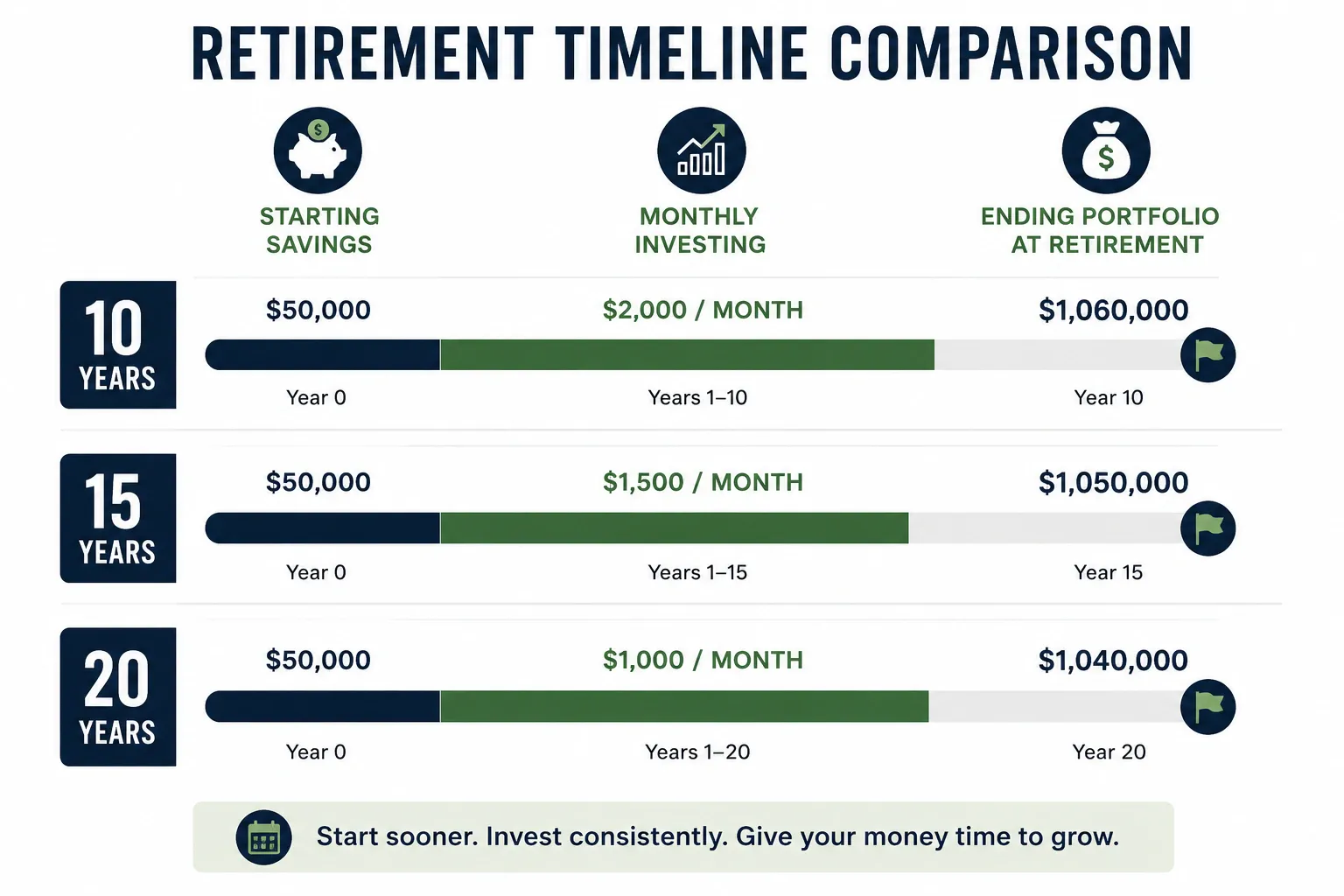
A 10-year timeline is the most demanding of the three scenarios in this article, and this section is intentionally blunt: there's limited room for error, and half-measures rarely close a meaningful gap in this short a window.
Closing a large retirement gap in 10 years typically requires some combination of:
A significantly higher savings rate than would be needed with more time
Increased income, since expense-cutting alone often isn't enough
A later retirement age, even by two or three years, which reduces both the savings target and the number of years the portfolio must support
Lower retirement spending expectations, adjusted realistically rather than optimistically
A partial-retirement phase, where part-time income supplements the portfolio in the early retirement years
None of these are pleasant to consider, but pretending a 10-year timeline doesn't require real changes is far more damaging than confronting the math directly now.
10-Year Example
Age: 55
Current savings: $250,000
Target portfolio: $1,000,000
Retirement age: 65
Assumed return: 7% annually
Monthly investment: $2,900 total ($2,700 from the household, $200 employer match)
At this contribution level, the $250,000 starting balance grows to approximately $491,787 through compounding alone over 10 years. The monthly contributions add roughly $501,932 more. That produces a projected ending balance of about $994,000 - a small remaining shortfall of roughly $6,000 against the $1 million target, easily closed with a modest annual contribution increase or one extra year of saving.
How Much Do You Need to Retire in 15 Years?
Five additional years changes the math more than most people expect. With 15 years instead of 10, compounding has meaningfully more time to work, which reduces the monthly contribution required to hit the same target; often substantially.
This extra runway also creates flexibility that a 10-year plan doesn't allow: more room to adjust asset allocation gradually, more time to recover from a market downturn, and less pressure to make dramatic income or lifestyle changes all at once.
15-Year Example
Age: 50
Current savings: $150,000
Target portfolio: $1,000,000
Assumed return: 7% annually
Monthly contribution: $1,850 total ($1,650 household, $200 employer match)
The starting $150,000 grows to approximately $413,850 over 15 years through compounding alone. Monthly contributions at this level add roughly $586,394. Combined, this produces a projected balance of about $1,000,244; landing almost exactly on the $1 million target.
At a 4% withdrawal rate, this portfolio would support approximately $40,000 in annual retirement income, before factoring in Social Security or other guaranteed income sources.
How Much Do You Need to Retire in 20 Years?
A 20-year timeline offers the clearest illustration of what compounding can do - including for someone starting from little or nothing. It's important not to overpromise here: the outcome still depends heavily on consistent contributions and a reasonable investment return. But 20 years is genuinely enough time for modest, steady contributions to build a meaningful portfolio.
20-Year Example
Age: 45
Current savings: $0
Target portfolio: $1,000,000
Assumed return: 7% annually
Monthly contribution required: $1,920 total ($1,720 household, $200 employer match)
Starting from zero, consistent monthly contributions of $1,920 over 240 months at a 7% average annual return produce a projected balance of approximately $1,000,000 - reaching the target almost exactly through contributions and compounding alone, with no starting balance at all.
One additional lever worth noting: increasing contributions gradually - for example, by 2-3% each year to keep pace with rising income - can reduce the initial required monthly contribution significantly while still reaching the same target, since later, larger contributions benefit from a growing account balance.
Compare the Three Timelines
This table highlights something worth sitting with: a 20-year investor starting from nothing, contributing a comparatively modest $2,000 a month, ends up nearly matching the outcome of a 10-year investor who started with a $250,000 head start and contributed far more each month. Time doesn't replace the need to save — but it dramatically reduces how hard you have to work for the same result.
(For a deeper comparison and full strategy breakdown, see The Ultimate Late-Start Retirement Guide: How to Build Wealth After 40.
What If You Cannot Invest Enough?
If your required monthly contribution feels out of reach given your current budget, you're not out of options - you have five real levers, and most successful late-start plans use more than one at the same time:
Invest more each month - even a modest increase, sustained over years, compounds meaningfully.
Increase your income - through a raise, side income, or career change, directing the increase straight to retirement contributions.
Reduce expected retirement spending - a realistic, deliberate adjustment rather than an emotional cut.
Work longer - even two or three additional years reduces your required portfolio and extends your accumulation window simultaneously.
Delay Social Security - waiting past full retirement age increases your guaranteed monthly benefit, directly reducing your portfolio income gap from Step 3.
Beyond these five, consider downsizing to reduce housing costs, relocating to a lower cost-of-living area, or planning a phased retirement where part-time income bridges the gap during the early transition years. There's no single "correct" lever - the right combination depends on your specific gap and your priorities.

Common Calculation Mistakes
Even a well-intentioned retirement calculation can produce a misleading number if it rests on flawed assumptions. Watch for these common errors:
Using an unrealistic investment return - assuming 10-12% annual returns to compensate for a late start often leads to underfunding the plan.
Ignoring inflation - a nominal return without an inflation adjustment overstates future purchasing power.
Forgetting retirement taxes - withdrawals from traditional 401(k)s and IRAs are taxable; failing to account for this overstates spendable income.
Underestimating healthcare costs - particularly before Medicare eligibility at 65.
Assuming Social Security will cover most expenses - for most households, it covers a meaningful portion, not the majority.
Treating a withdrawal rate as a guarantee - it's a planning assumption that should be revisited as markets and circumstances change.
Counting the house as both a residence and a liquid asset - unless you have a specific plan to downsize or relocate, home equity shouldn't be counted as available retirement income.

Your 90-Day Retirement Catch-Up Plan
Month One: Calculate the Gap Gather every account balance, estimate your Social Security benefit, and complete Steps 1 through 6 above to determine your specific retirement number.
Month Two: Increase Contributions and Fix Asset Allocation Raise your monthly contribution toward the target identified in your calculation, and review whether your current investment mix matches your actual timeline and risk capacity.
Month Three: Automate the Plan and Identify One Income-Growth Strategy Set up automatic contributions so your savings rate no longer depends on willpower, and identify one realistic way to increase your income - even modestly — and commit that increase directly to your retirement plan.
Conclusion
Being behind on retirement doesn't mean the goal is out of reach; it means the plan has to be built around your real timeline instead of a generic rule of thumb. Whether you have 10, 15, or 20 years left, the same process applies: calculate your spending, subtract guaranteed income, determine your portfolio target, and adjust the levers available to you.
The numbers in this article are a starting framework. Your next step is running your own and for the full strategy behind building wealth on a compressed timeline, read The Ultimate Late-Start Retirement Guide: How to Build Wealth After 40.