
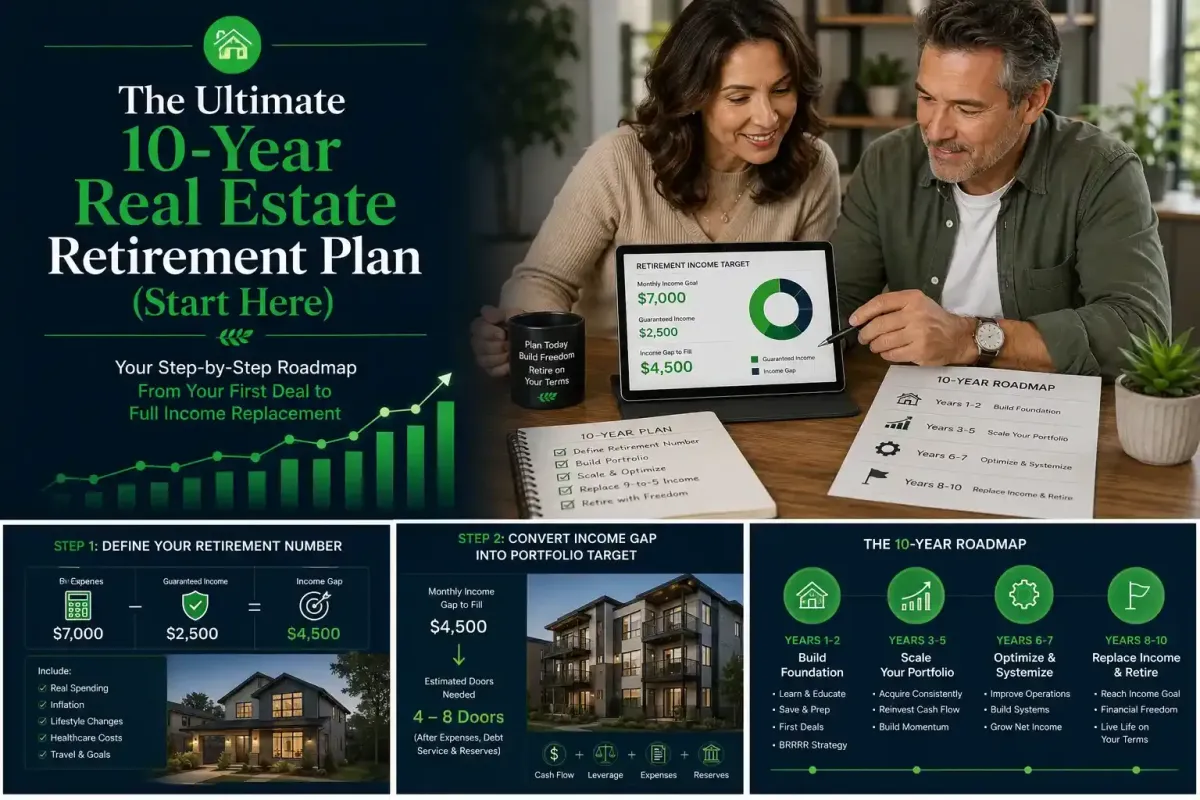
The Ultimate 10-Year Real Estate Retirement Plan
If you want real estate to replace your 9 to 5 in 10 years, the first step is not buying a property. It is defining the income that property portfolio must produce.
Most people over 40 who get interested in real estate investing start in the wrong place. They start browsing listings. They start watching videos about flipping houses. They get excited about a deal before they know what the deal is supposed to accomplish. That order of operations is exactly why so many real estate plans stall out or collapse under stress.
This guide flips that order. You are going to work backward from the income you actually need, then forward into a phased 10-year roadmap that gets you there. No guessing, no hype, no assuming a market will bail you out. Just a conservative, honest plan built the way a real business is built.
The Ultimate 10-Year Real Estate Retirement Plan
Step 1: Define The Retirement Number
Step 2: Convert That Income Gap Into A Portfolio Target
Step 3: Choose The Right Strategy Mix
Step 4: Build The 10 Year Roadmap
Step 6: Build Operating Systems
Step 7: Manage Risk And Protection
Step 8: Measure Progress Annually
Full disclaimer. I personally don't want the hassle of owning real estate as an investment due to my traveling. I do invest passively in real estate with the additional tax benefits.
Step 1: Define The Retirement Number
Before you buy a single property, you need to answer a question most people skip entirely. How much monthly income does retirement actually require?
Start by pulling 6 to 12 months of real spending. Not a budget you wish you followed. What you actually spent. Then adjust that number for how retirement will change your lifestyle.
Maybe the mortgage will be paid off by then. Maybe healthcare costs go up. Maybe you finally take the trips you have been putting off. Build in inflation too, since a dollar 10 years from now will not stretch as far as it does today.
Once you have that number, subtract any guaranteed income you already expect, such as Social Security or a pension. What is left is your income gap, and that gap is the exact number your real estate portfolio needs to cover.
Here is a simple example. If a household needs $7,000 a month in retirement and expects $2,500 a month from other guaranteed sources, the portfolio needs to produce $4,500 a month. That single number becomes the target for everything that follows.
Step 2: Convert That Income Gap Into A Portfolio Target
Once you know your monthly income gap, you can translate it into a real estate target using a conservative cash flow assumption.
Most experienced investors work with a range rather than a fixed number, because cash flow depends on your market, your leverage, your expenses, and your vacancy rate. A duplex in one city and a duplex in another can produce very different net income even at similar purchase prices.
This is one reason Dave Meyer, VP of Data and Analytics at Bigger Pockets and author of Start with Strategy, pushes investors to define their strategy and their numbers before they define their market.
As a rough starting point, many investors think in terms of doors, meaning individual rental units, rather than properties. Depending on price point and market, closing that $4,500 a month gap might take somewhere between 4 and 8 doors, once you account for realistic expenses, debt service, and reserves.
The goal here is not to hit a specific property count for the sake of a number. The goal is stable net income after every real cost is accounted for. A portfolio of 10 properties that barely breaks even is worth less than a portfolio of 5 properties that reliably cash flows.
Step 3: Choose The Right Strategy Mix

Real estate is not one strategy. It is several, and the right mix depends on your time, your capital, and your risk tolerance, not on whichever strategy is trending in your feed right now.
Buy and hold rentals are the foundation for most people running this kind of 10 year plan, because they are the most predictable and the easiest to manage part time. Small multifamily properties, meaning duplexes through fourplexes, often give you better cash flow per unit than single family homes, since you are spreading fixed costs like the roof or the water heater across more doors.
Value add properties, where you buy something underpriced, improve it, and increase the rent, can accelerate your timeline, but they take more skill and more attention. Commercial or specialized assets tend to make more sense later in the plan, once you have experience and capital behind you.
If you are starting later in life, there is a strong case for starting smaller than you think you should. A single, unglamorous rental property that you fully understand teaches you more than a complicated deal you do not fully understand.
Leverage, meaning borrowed money used to control a larger asset, can speed up your growth significantly. It can also wipe out a decade of progress if it is used carelessly. Conservative leverage is not a lack of ambition. It is what allows you to survive long enough to reach year 10.
Step 4: Build The 10-Year Roadmap
This is where the plan becomes concrete. Break the 10 years into four phases.
Years 1 and 2 are about education, saving, strengthening your credit, and making your first acquisitions. This is also where the BRRRR strategy, which stands for buy, rehab, rent, refinance, repeat, becomes useful.
You buy a property below market value, improve it, get it rented, then refinance to pull most or all of your original capital back out so you can do it again without needing a fresh pile of savings for every deal.
Years 3 through 5 are about scaling. You already understand your numbers and your systems from the first phase, so each new deal should move faster and with less friction than the last. This is also the phase where you start reinvesting cash flow instead of just watching it accumulate.
Years 6 and 7 are about tightening the operation. Your portfolio is growing to the point where it can start to strain your time if you are not careful. This is when many investors bring in property management or build out simple systems, because your time has become more valuable than the fee you are paying to protect it.
Ken McElroy has said for years that investors who scale successfully treat real estate like a business, not a hobby. This phase is where that mindset either gets adopted or the plan starts to break down.
Years 8 through 10 are about shifting from building mode to income mode. You stop pulling equity out aggressively and start paying down debt instead, since lower debt means lower risk and higher monthly cash flow per property. You also build in margin, meaning your portfolio should produce more than your target number, not exactly your target number, so a bad month does not derail your retirement.
Step 5:

Every phase of this plan runs on capital, so you need a clear picture of your capital stack. That includes down payments, conventional loans, private money, potential partnerships, and reserves.
Before you try to scale aggressively, build a financial cushion of 6 to 12 months of expenses. This is not optional. It is what keeps one vacancy, one major repair, or one interest rate reset from turning a manageable setback into a plan ending crisis.
Maintaining liquidity throughout the plan, rather than putting every available dollar into the next deal, is what separates investors who make it to year 10 from investors who get forced out in year 4.
Underwrite every deal conservatively. Use realistic rent assumptions instead of best-case numbers. Assume expenses will run higher than you expect. Build in a vacancy allowance even in a strong market. If a deal only works when everything goes right, it is not a deal you want inside a 10-year retirement plan.
Step 6: Build Operating Systems
A retirement portfolio is a business, even if it never feels like one at first. Treat it that way from the beginning.
That means property management, whether self-managed or outsourced, bookkeeping that actually gets updated, a real tenant screening process, a maintenance workflow, and annual tax planning instead of a scramble every April.
A strong team, meaning your agent, your lender, your contractor, your property manager, and your accountant, reduces the number of things that can quietly go wrong.
It also means building your own financial intelligence over time. You do not need to become an accountant, but you should understand the basics of leverage, taxes, and market cycles well enough to ask good questions and catch problems early.
Step 7: Manage Risk And Protection

The biggest threats to this plan are not exotic. They are ordinary and predictable: vacancies, repairs, interest rate changes, overleveraging, difficult tenants, and too much concentration in a single market.
Conservative underwriting and healthy reserves are a form of insurance against all of them. Add real protection on top of that, including adequate insurance coverage, a sound legal structure for how you hold your properties, and diversification across markets or property types where it makes sense for your situation.
Real estate can absolutely support a retirement plan. It should never depend on the best-case scenario actually happening.
Step 8: Measure Progress Annually
A 10-year plan only works if you check it every year. Track your monthly cash flow, your equity growth, your debt paydown, your reserve coverage, and the number of stabilized, fully rented units in your portfolio.
Once a year, compare your actual performance against your original plan. If you are ahead, decide whether to accelerate. If you are behind, decide whether to adjust your acquisition pace, increase your savings rate, or extend your timeline. A simple yearly scorecard, even a basic spreadsheet, keeps you honest and keeps small problems from becoming big ones.
Step 9: The Exit Phase
At some point, the portfolio genuinely replaces your earned income, and that moment deserves its own plan. Define a withdrawal or distribution approach that protects your cash flow and keeps your reserves intact rather than draining them.
This is also the phase where you transition from building mode to income mode for good. Some investors keep reinvesting a portion of cash flow. Others start taking more out to fund the retirement they built this whole plan for.
Either way, think through lifestyle design in advance. What work becomes optional. What still needs your attention. And how to avoid overspending in those first free years, when the temptation to celebrate a decade of discipline all at once is strongest.
Step 10: Common Mistakes To Avoid
A handful of mistakes account for most of the real estate retirement plans that fail.
Relying on appreciation instead of cash flow. Assuming rents will rise faster than expenses. Underestimating vacancies, repairs, or financing costs. Scaling before you have built real reserves and real systems. Buying properties that are more complex than your current skill level can handle.
None of these mistakes are exotic. They are all avoidable with the kind of conservative, phase by phase approach outlined above.
The Bottom Line
A 10-year real estate retirement plan works when it is built backward from the income you need, not forward from whatever deal happens to show up first. Define your number. Convert it into a portfolio target. Choose a strategy mix that fits your time and risk tolerance. Move through the phases in order. Review your progress every year and adjust honestly.
Ten years is a realistic timeline for this if you follow it in order. It is not a realistic timeline if you try to skip phases to catch up faster, because that is exactly what turns a solid plan into a costly setback.
If you want a structured way to work through your own numbers, including your retirement gap, your portfolio target, and stock strategies that complement a real estate plan like this one, that is exactly what the Execution Signals Membership was built to help with.